
Going the Distance? How Far Should A Beginner Hit A Golf Ball?

The moment you hit your first few balls, you want to know one thing: how do I compare?
And the comparison every golfer reaches for first is distance. So how far should a beginner hit a golf ball?
The good news is that Arccos, golf’s first Artificial Intelligence shot tracking platform tracks almost 10 million amateur golfer’s drives a year and here’s what they found on this.
On average beginner men golfers with handicaps of over 30 drive 181 yards or 165.5 metres. This compares to an overall distance average for all male amateurs of 224 yards or 205 metres. Beginner women golfers hit their drives 145 yards (133 metres) compared to an overall average of 176 yards (161 metres)
Those are overall averages though, not targets, and the spread across different golfers of different handicaps and ages is huge.
That’s why in this post we’ll look at what’s realistic, how far beginners should expect to hit every club, how to measure your own numbers, and how to add yards without wrecking your swing.
 Golfing Focused Takeaways For Time Pressed Golfers
- Beginner men average around 181 yards off the tee, women around 145 yards
- Most beginners swing the driver 60 to 80 mph, and every extra 1 mph of club/swing speed is potentially worth up to 3 yards with the driver.
- Distance helps you score, even as a beginner. Don’t leave the driver in the bag because distance matters more for amateurs than accuracy.
- Knowing your own yardages beats chasing anyone else’s
Beginner Golfers Are Hitting the Ball Further Than Ever But …
How far golfers hit the ball clearly depends on a lot of factors and beginner players are no exception.
Distance is determined affected by factors such as gender, age, your fitness levels and athleticism, the clubs and balls you are using, the weather, course conditions, swing speed, timing, launch conditions and so on.
Despite these multiple variants, all golfers are now hitting the ball further than they did 30 years ago as huge technical advances (e.g. oversized drivers, multi-layered golf balls) have resulted in everyone driving ever greater distances.
And the even better news for beginner golfers is that between 1996 and 2018 this group saw the biggest advance of driving distance compared to other amateurs.
While the average male golfer gained about 15 yards over that period high-handicapped golfers gained the most at roughly 22 yards.
Since then though according to Arccos’s the driving distances of beginners and the average golfer have stalled.
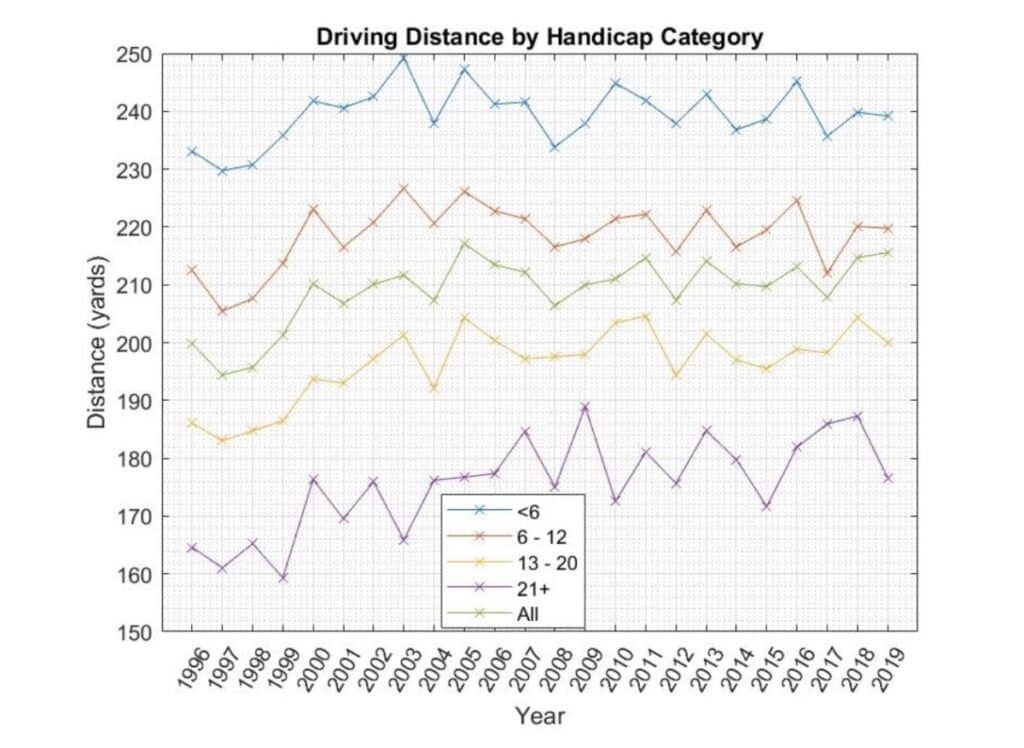
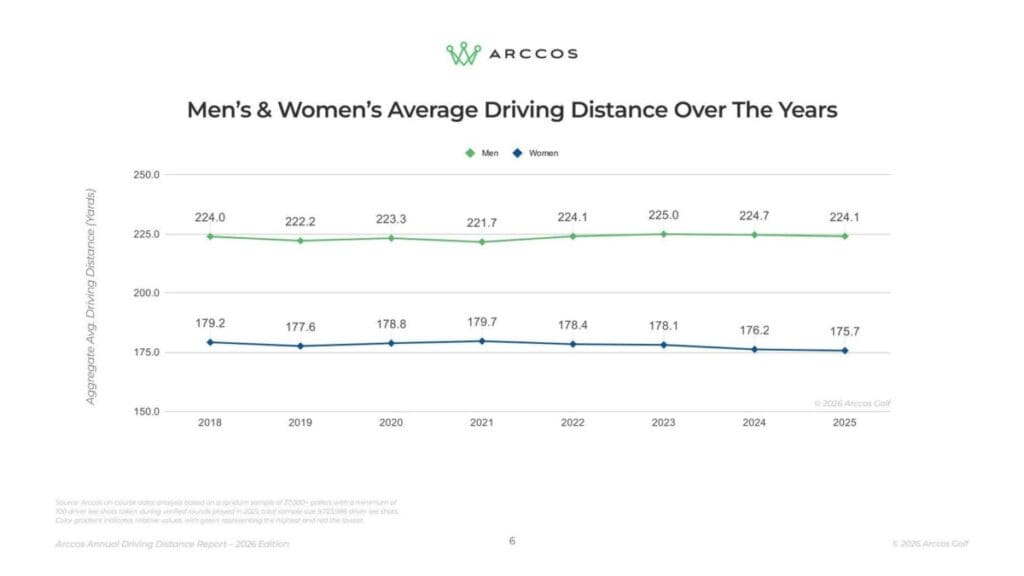
Here’s what the data also critically says though and it’s worth hearing because as a beginner you’ll be told the opposite plenty.
- There is a clear link between driving distance and handicaps – the longest hitters genuinely tend to have lower handicaps.
- Driving distance matters more for amateur scoring than accuracy.
So no, chasing distance isn’t a beginner’s mistake.
Wild, uncontrolled distance but any beginner serious about getting meaningfully better will have to try and hit the ball consistently farther to progress.
To achieve the basic goal is more swing speed – a typical beginner swings the driver at around 60 to 80 mph – with solid contact, not laying back and you’ll find a 5 quick tips below to help you hit the ball further.
“For pros, driving distance is more important than driving accuracy. For amateur golfers, driving distance is even more important for scoring than driving accuracy.”
Mark Broadie, Columbia Business School professor, author of ‘Every Shot Counts’ and pioneer of the ‘strokes gained’ metrics adopted by the PGA Tour
How Far Should Beginners Hit Each Golf Club
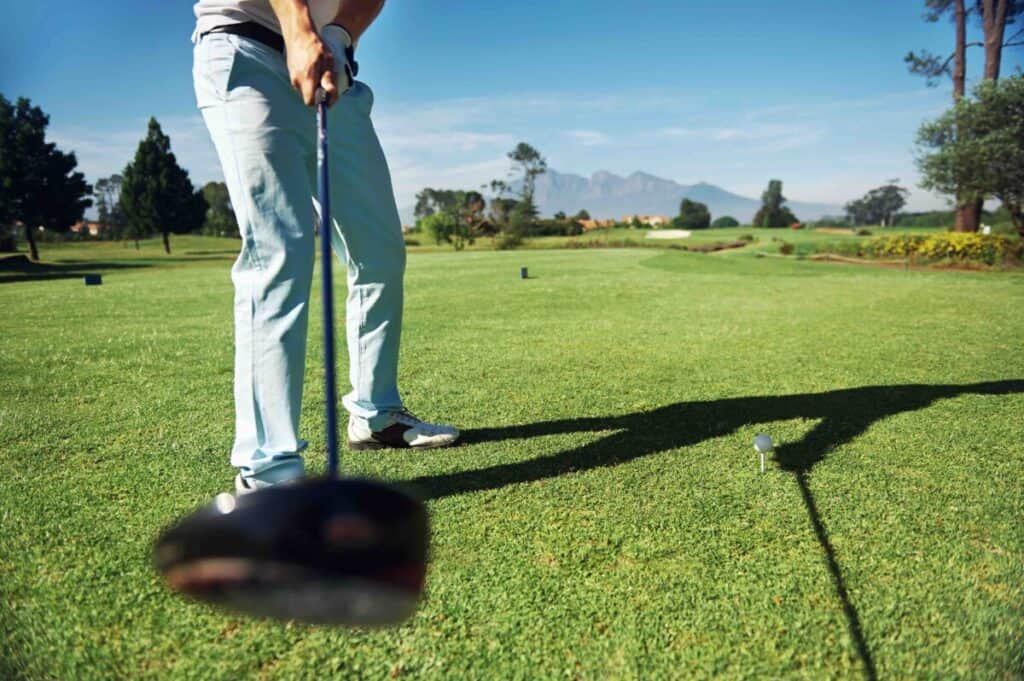
While the Annual Driving Distance Report gives clear data on how far golfers hit their drivers there is no comparable official data for how far beginners hit other clubs.
Our research has however found estimates of how far the average golfer hits each golf club.
And based on the fact that the Annual Driving Distance Report recorded a 14% difference for men and 7% for women in how far beginners with a handicap of 21 and over hit their driver compared to the average player we have applied that same difference to the other clubs.
We have therefore estimated that beginners on average hit the golf ball the following distance for each club:
| Club | Beginner Men – Average distance (yards) | Beginner Women – Average distance (yards) |
| Driver | 176.6 | 119.8 |
| 3-wood | 155 | – |
| 1-iron / 1 Hybrid / 4-wood | – | – |
| 2-iron / 2 Hybrid / 5-wood | 138 | 115 |
| 3-iron / 3 Hybrid / 7-wood | 129 | 105 |
| 4-iron / 4 Hybrid / 9-wood | 127 | 97 |
| 5-iron / 5 Hybrid / 11-wood | 124 | 88 |
| 6-iron | 115 | 80 |
| 7-iron | 107 | 72 |
| 8-iron | 98 | 63 |
| 9-iron | 89 | 55 |
| Pitching wedge (PW) | 80 | 47 |
| Gap wedge (GW) | 67 | 40 |
| Sand wedge (SW) | 58 | 33 |
| Lob wedge (LW) | 48 | 25 |
With the ever-expanding variety of modern-day golf clubs, and some sets of clubs having strong lofts on them and some woods now coming with weaker lofts to make them easier to hit, estimating average distances for clubs is increasingly difficult to do.
This table however should give you a rough idea of how far other beginners are roughly hitting the ball with different clubs.
How to Measure How Far You Hit Your Golf Clubs
Although comparing how far we hit the ball compared to others is always fun and interesting to know what is most important is knowing how far individually hit each club. If you have 128 yards to the green for your next shot it does not really matter what club the average player should use.
All that matters is knowing what club you normally hit that distance most consistently. A guess is not really good enough if you really want to improve your game and your scores.
Thankfully measuring golf shot distance for each of your clubs is not difficult today, particularly with the number of technical options available which can make it even easier.
The best way to measure how far you hit your clubs is to follow these 3 simple steps:
- For each of your clubs hit 10 shots towards a target
- Measure how far you hit each one
- Finally, calculate the average distance you hit the 10 shots and keep a note.
If you hit a really bad shot though as one of your 10 shots simply do not count it and if you can use the same ball for all the shots that is absolutely ideal.
For the most accurate measurement of each shot you can use a laser range finder, smartwatch or GPS measuring device. If you do not have such a device though don’t worry – you can simply pace out the distance of each shot.
If you want to get even more detailed and professional about your approach to distances you can also keep a note of the longest and shortest distances you hit each club. This will then give you a distance range you hit each club and more club options for that important next shot.
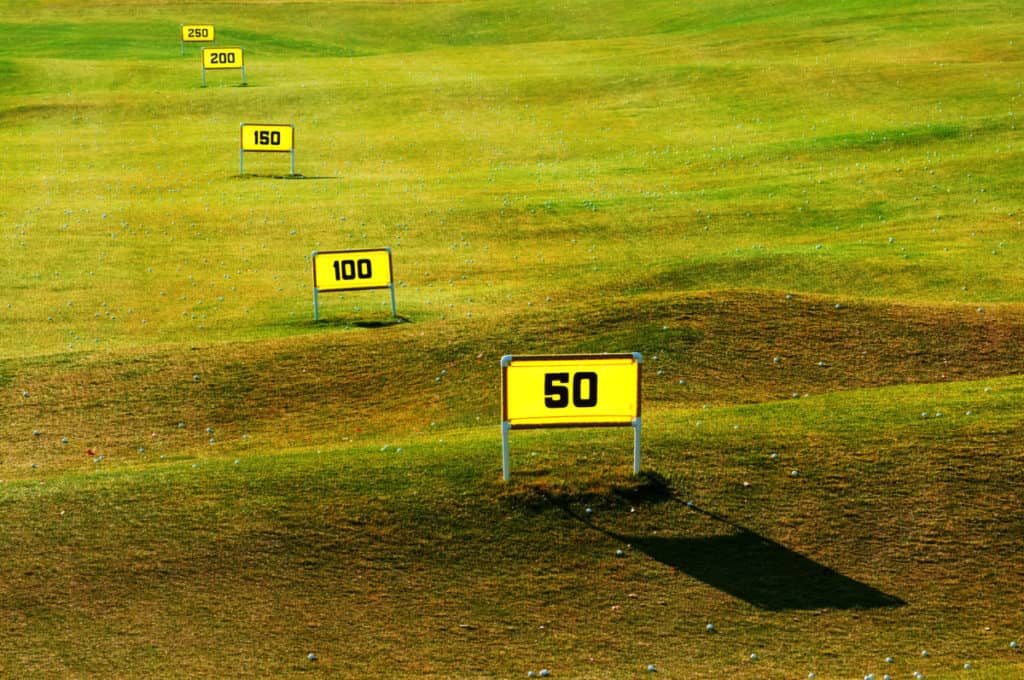
If this process isn’t easy for you to do though or seems a bit too much you could try simply hitting 3 balls for each club at your local driving range and use the yardage markers to give you a rough idea of how far you hit each club.
This will be less precise of course but if you are currently relying solely on guesswork for choosing what club to hit for your shots it will be a small improvement.
[Note – If you are interested in Arccos – Golf’s first artificial intelligence shot tracking platform – and getting an exact idea of how far you hit the ball so you choose the right club every time click here to get 15% off when you use our discount code – GOLFINGFOCUS15. Recognised by Golf Digest Editor’s awards 5 years running Arccos’ members improve by an average of 5 strokes in their first year of membership!]
5 Quick Tips on How Can Beginners Hit the Ball Further

Although learning to hit the golf ball consistently well and straight is obviously more important for beginners it is not always fun when you are starting to play golf watch everyone else hitting the ball a long way past you.
Every beginner golfer at some point gets the itch to hit the ball farther and for some players that desire never stops. And why not? It feels great to watch a drive fly into the distance and if you are hitting shorter shots into the green you are more than likely going to hit more greens and therefore improve your scores.
So to help those beginners who are desperate to start hitting the ball further as quickly as possible here are 5 quick tips to focus on:
- Change your ball – Golf balls have 3 main elements to them – the cover, layers and compression – and different manufacturers will make different combinations of each in different golf balls and some are specifically designed for distance. Lower compression golf balls are best for out and out distance and the good news is they are typically recommended for beginners.
- Watch your ‘grip’ – Grip in general is a key part of golf and critical to helping players swing well and hit the ball solidly. So to make sure you are giving yourself the best chance to hit the ball as far as you can take a look at both your golf club grips and golf shoes. Worn out grips make players hold the club tighter than they need to and this is likely to restrict the length and speed of your swing – 2 key elements when it comes to hitting the ball further. Poor grip on the ground from your golf shoes is also bad for distance as it will again lower clubhead speed. So make sure you’ve got a grip if you are looking to hit the ball further.
- Tee the ball higher – If you watch any golfer who hits the ball a decent distance you can be sure that they will not have pushed their tee peg a long way into the ground before they hit their driver. A more upward hit on the ball at impact is the friend of hitting it further as it both increases the ball’s launch angle and reduces backspin. So the next time you tee the ball up make sure you are teeing the ball up high to give yourself the best chance of getting those few extra yards.
- Choose your straightest club off the tee – Missing the fairway off the tee is one of the main enemies of hitting the ball further. Research has found that a ball that lands on the fairway will roll three times as far as those that land in the rough. That can translate to up to 18 yards of lost roll for the average player. So consider hitting your straightest club off the tee to maximise distance. Hitting your trusty 5 iron down the middle of the fairway may end up going further than a driver hit straight into the rough.
- Turn those shoulders and move those hips – Hitting the ball a long distance does not correlate directly to the size of the golfer. Ian Woosnam, the former Masters Champion and European Ryder Cup Captain, stands only 5ft 4 inches tall but throughout his career was one of the longest hitters in the game. To explain this it is important to understand the power in a golf swing comes from. Most amateur golfers when trying to hit the ball further will typically try to use their hands and arms more. But the key to generating power in the golf swing and therefore distance comes from the shoulders and hips. If you turn your shoulders at least 90 degrees and then lead with your hips as you start your downswing you will allow yourself to use your twisting momentum to generate faster clubhead speed. A faster clubhead speed means more distance.
It is difficult for all golfers, and especially beginners, not to worry about how far they hit the ball. ‘How far are you supposed to hit each of your golf clubs’ is one of the most asked questions in golf and we all want to hit the ball a certain distance.
Some golfers care more about distance than others but the honest answer is that how far players hit the ball depends on a multitude of factors and therefore distances between golfers will vary greatly – one golfer’s 9-iron distance can easily be another’s 6-iron.
As soon as you start playing the game you will quickly get an idea of whether you are a long or a short hitter compared to those you play with.
The trick is to focus on ‘your’ distances rather than those of your friends or the top professionals on television. There is no such thing as a ‘wrong club’ distance, there is only ‘your’ distance, so try to avoid hitting a certain club because you think that what you ‘should’ play or because that is what your friend is playing.
Hitting the ball a long way does not mean you will automatically shoot a low score. So get to know your own yardages as early as you can – as you play more and improve you will likely start to hit the ball further and further – and always remember that hitting it straight onto fairways and greens rather than far will typically mean you score better.
Before You Go ….
To be able to hit the ball farther you need to know what makes are the key factors that impact distance. Check out exactly what these are in our next post.
What Determines Driver Distance?
More articles related to this topic:
- Why Don’t Your Drives Go Far? Slow and Steady Loses the Race
- How Far Should Your Ball Speed Go? 100mph All the Way to 210mph!
- How Far Should Your Driver Swingspeed Go? 60 to 120 mph Guide
- How Far Should You Hit a Driver? FULL GUIDE By Age, Handicap etc.
- How Far Should You Hit Your Wedges? Be Sure to Fill the Gaps!
- Should Beginners & High Handicappers Use a Driver? Yes & Yes
- The 5 Best Tips for Beginner Golfers Follow the KIS Principle
- Is Golf Hard to Play? Well …. it’s Complicated
- How Many Clubs Does a Beginner Need? Save Your Money to Start With!
- Should High Handicappers Get Fitted Clubs? The Benefits Apply to All
- What is an Up and Down in Golf? It’s Important to Know
- Are You Average? A Complete Guide to Average Golf Handicaps
- Complete Guide to the Good, the Bad & the Ugly of Golf Scores
- Are Hybrid Irons Easier to Hit? 7 Reasons to Choose the Easy Way
- 5 Fun Buddy Golf Trip Games for a Wide Range of Handicaps
- Should I Get Fitted for Golf Clubs Before Lessons? Get Both Together
- How Often Do Pros Hit Driver? Not As Much As You Think!
RECENT ARTICLES


LEGAL INFORMATION
This site is owned and operated by Golfing Focus Limited, a private limited company whose registered office is in London, UK. Golfing Focus Limited is a participant in the Amazon Services LLC Associates Program, an affiliate advertising program designed to provide a means for sites to earn advertising fees (at no cost to you) by linking to Amazon.com. Golfing Focus Limited also participates in other affiliate programs with the eBay Partner Network, FlexOffers, CJ.com, Svorn and other sites and is compensated for referring traffic and business to these companies (again at no cost to you).
Our Socials
Leave a Reply