
Should All Your Wedges be the Same? Focus on Gaps & Variety


Long gone are the days when a set of golf clubs simply contained a standard 50° pitching wedge and 56° sand wedge.
In the modern game there are now a bewildering array of grind, bounce and finish options from wedges lofted 44° all the way to 64°!
Such a volume of choice to meet any golfer’s needs is of course great but it’s also led to confusion, wasted money, and amateur bag wedge line-ups that are more haphazard than harmonious.
So to cut through the complexity should your approach simply be to make all your wedges the same?
The short answer is no – golf wedges should not automatically be the same.
Wedge lengths, lie angles and shafts are best to keep consistent to deliver good distance gapping but grinds and bounces are good to vary to help maximise the variety of wedge shots you can play.
Part of the problem many amateur golfers have is that they get caught up with the seemingly endless options for wedge combinations of bounce, grind, finish etc and forget to themselves the right practical questions that help them to choose their best wedge set up.
Given research shows a quarter of all shots are played with a wedge it’s clearly important players get this right.
So in the remainder of this post we’ll cut through the jargon — grind, bounce, raw/finished faces, groove tech etc — and focus on what golfers actually need from their scoring clubs: distance coverage, the right combination of shots that suit your course conditions, and confidence over the ball.

 Golfing Focused Takeaways For Time Pressed Golfers
- Don’t buy “matching” wedges — build distance coverage + shot options. Your wedge setup should remove awkward in-between yardages inside 100 yards, not look tidy in the bag.
- Start with your pitching wedge loft and carry. Modern PW lofts can be very strong, so your wedge gaps can be broken before you even buy a new wedge.
- Keep the boring wedge specs consistent. Similar shaft/weight, length and lie angle help wedges feel and fly predictably — then bounce/grind changes actually mean something.
- Vary bounce and grind to match your course and delivery. Soft parkland + steep divots usually want more bounce; firm links + shallow strikes need less.
- Brand and finish are secondary. Same-brand can help feel/confidence, PW/GW often suit more forgiving “iron-like” designs, and finish is mainly visual — results and coverage come first.
What ‘The Same’ Wedges Actually Means!
When golfers ask whether all their wedges should be the same, it helps to first unpack what “the same” could mean. Often people assume it refers to one club element and overlook the rest.
But here are all the different ways you can interpret it in relation to wedges:
- Same BRAND – Wedges are all made by the same golf club manufacturer (e.g. Titleist, Callaway, TaylorMade, Srixon etc)
- Same FINISH – Chrome, Black or Raw for example
- Same TYPE/STYLE – Specialist blade wedges vs. cavity backs or players distance vs game-improvement wedges — essentially the overall design philosophy of the head.
- Same BOUNCE / GRIND – Identical ‘bounce angles’ – the angle created between the leading edge of your wedge and the sole/trailing edge – or ‘grinds’ (i.e. the ‘shape’ of the sole of the wedge
- Same SHAFT / LENGTH – Do the wedges have the same make, model, length, weight and flex of shaft?
- Same LIE ANGLE.
As we can immediately see a large number of elements need to be identical for wedges to the truly ‘the same’ but here’s the key thing – some of these matter far more than others for performance – especially for regular amateurs.
Brand and finish are mostly aesthetic — they can help your confidence, but they don’t inherently make the clubs perform better for your game.
Type and sole design do matter — but in specific contexts and roles (e.g. a forgiving cavity wedge for full swing shots vs a versatile specialist blade wedge for around the green) – meaning they shouldn’t be the same across your wedge set up for uniformity’s sake.
Meanwhile consistent wedge loft gaps, lengths, lie angles and shafts have a the most direct impact on how predictably your wedges launch, carry and land.
So before we move on to answer “should all your wedges be the same?”, let’s first agree on this:
- Matching the right wedge specs will improve performance.
- Matching just for looks or because of a brand story rarely does.
Now in the sections that follow we’ll explore which of these “same” club elements are worth pursuing — and which ones are better thought of as variable or optional.

Mind the Gaps, Your Game & Conditions Before ‘Matching’ Wedges
But even before we get into whether your wedges should be the same brand, finish, bounce, grind, length etc etc it’s vital to firstly turn your Golfing Focus to what wedges are actually for – getting the ball in the hole in as few shots as possible – especially from 100 yards or so in!
As the late great Seve Ballesteros, who alongside Phil Mickelson is regarded as the best wedge player that has ever played the game, put it – “Golf is not how it’s how many!”
So the key initial question isn’t really “should my wedges match?”. It’s “do my wedges help me cover the shots I actually face — on the courses I actually play?”
The 3 wedge priorities to consider before ‘matching’
1. WHERE you play most of your golf
Your wedge setup should reflect your usual conditions.
- Parkland / soft turf / fluffy sand / thick lush rough tends to reward more help through the turf through more wedge ‘bounce’.
- Links / firm turf / tight lies / firmer sand often needs wedges with ‘low bounce’ that don’t dig and can be flighted low into the wind.
That’s why copying someone else’s “perfect matching” wedge set is a great way to buy the wrong tool for your job.
Rory McIlroy also frames it in terms of what your course demands from your bag overall:
“If your home course is on the longer side, maybe consider going with just three wedges because you’d probably benefit from another hybrid or fairway wood. The opposite would be the case for shorter courses where you’ll have more wedges in your hand.”
Rory McIlroy
We go deeper on how many wedges you should carry in a separate article — the key point here is: your course should influence your wedge priorities and what specs you should look to match vs. experiment with.
2. Your ABILITY and PREFERENCES
The next key factor affecting your wedge selection is simply your ability and preferences.
Be honest with yourself: are you comfortable with partial wedge shots? Confident from bunkers? A big divot-taker or do you nip the ball off the turf?
If you struggle controlling ¾ and ½ swings (most regular golfers do!), a wedge setup that gives you more stock, repeatable yardages with full swings will usually beat one designed for “maximum versatility” in theory.
Consider your wedge strengths and weaknesses first and again what wedge specs you need to vary vs. match will become more obvious.
3. GAPS, GAPS, GAPS
This is the big one and the single most important factor when it comes to ensuring you have as many bases covered as possible in terms of the ‘variety’ of wedge shots you can play.
The most common reason wedges don’t work for amateurs isn’t that the bounce or grind or shaft don’t match … it’s that the distances don’t make sense because the loft ‘gaps’ are wrong.
Modern irons have made this worse, because pitching wedges have got stronger and stronger, going all the way down to 43°.
So start here:
- Check your pitching wedge loft (don’t assume — measure if you can).
- Know its carry distance.
- Build the rest of your wedges so you don’t live in “in-between” land.
Bob Vokey, one of the world’s foremost wedge designers, guidance is a useful starting framework – he likes 4-6° between wedges which often works out around 10 to 15 yards for most male golfers.
Female and junior golfers will have 5 to 10 yard gaps by comparison.
This equal spacing, the vast majority of golf club fitters then agree, makes it easier for players to cover as many of the variable distances under 100 yards as possible and minimise those often dreaded ‘in between’ distance wedge shots.
But always remember it’s the consistent gapping in distance rather than loft which is the most important thing!
“It’s an ongoing battle against spin. It’s not all about how much spin you get. Gapping is the main criteria rather than spin. Spin is overrated.”
Bob Vokey, Titleist Master CRAFTSMAN AND ONE OF THE WORLD’S LEADING WEDGE DESIGNERS
Should All My Wedges be the Same Brand, Type and Finish?
Now that we’ve got the real wedge priorities nailed down – distance gapping, conditions, confidence – we can start talking about the stuff golfers usually mean when they ask “should my wedges match?” — brand, head style, and finish.
Same ‘brand’ wedges: helpful not a rule
There are reasons some fitters like golfers to keep wedges the same brand. Different manufacturers do have their own “take” on faces, grooves and materials — which does influence launch, spin and carry.
Nick Sherburne founder at Club Champion, a Golf Digest 100 Best Clubfitter put it like this:
“We see so many golfers come through with a bouquet of brands of wedges. Remember they all have their own twist on material, grooves, face roughness etc. These factors will also have an impact on ball speed and spin, and those two factors have a lot to with the distance you hit a wedge. Having a consistent wedge brand set up with neutralize that and leave you with better-gapped wedges, that go the distances you need them, shot after shot.”
So yes: same-brand wedges is a smart starting point for testing, especially if you gain confidence from a consistent look and feel.
But it’s not something to treat like a strict rule.
The big downside is cost and flexibility.
If for example you later discover one particular wedge from another manufacturer clearly performs better for you, a strict “every wedge brand must match” rule can force you into replacing all your wedges — and that’s an expensive way to protect a logo.

A better approach: start with your preferred brand, but let the final decision be driven by:
- your usual playing conditions,
- your ability and preferred shots,
- and whether the wedges give you the gaps you actually need.
If your wedges end up ‘brand’ mixed because the results are better… that’s not “wrong.” That’s smart.
Same “type” of wedge: match the job instead
Making all your wedges cavity back or blade style is where “matching” can matter more — not because it looks tidy, but because different wedge designs suit different roles.
A really useful way to think about it is:
- Pitching Wedge (PW) + Gap or Approach Wedge (GW) are often full-swing clubs
- Sand Wedge (SW) + Lob Wedge (LW) are often partial-swing / bunker / greenside clubs
Award winning clubmaker and clubfitter Jim McCleery sums up that logic brilliantly:
“For most clubs and most players today, the pitching wedge and gap wedge are full-swing clubs, while the sand wedge and lob wedge are used for bunker shots and high-loft partial shots from the rough. Only if the player has more skill and high swing speed will I suggest that the gap wedge be a speciality blade type of wedge.”
So for many golfers, especially higher handicaps:
- Cavity-back / game-improvement style PW and GW likely make more sense (more forgiving, more consistent on fuller swings).
- SW and LW are where you can experiment more with specialty/blade wedges if you actually use them for creativity and have the ability to strike them consistently enough to benefit.
Remember it is hard to hit full-swing shots with speciality blade-style wedges.
In short: don’t force every wedge to be the same “type.” Make each wedge earn its spot based on the role it plays for your game.
Same finish? Choose what you like and ignore the myths
Wedge finish (i.e. chrome, brushed steel, jet black, oil can, raw etc) is mostly preference — especially visually — and it shouldn’t drive your wedge buying decisions.
One of the biggest myths is that rusty/raw wedges automatically create more spin.
There has never been any firm proof to support this idea though and indeed on testing by Today’s Golfer found that the standard chrome wedge performed better than its ‘raw’ counterpart.
The truth is: modern laser-milled groove and face technology does the heavy lifting now in terms of spin , so the “rust = spin” argument is often overstated.
That said, raw finishes can have two practical benefits:
- Less glare in bright sunny conditions
- Clearer wear marks on the face over time give helpful feedback on strike location.
Otherwise? Chrome, brushed, black, raw… pick the one you enjoy looking down at and move on.
Bottom line:
- Brand matching: useful starting point, not a rule.
- Type matching: match wedge design to wedge role (full swing vs greenside).
- Finish matching: completely optional — choose what you like.
And as always: the only “matching” that really counts is your wedges matching the shots you actually face.


Should All Your Wedges Have the Same Bounce and Grind?
Bounce and grind are the two wedge specs golfers talk about most.
But before we answer whether they should be the same across all wedges, here’s the simple definition.
In short ‘bounce’ is the angle created between the leading edge of your wedge and the lowest point of the sole or trailing edge.
This is the area of the club that hits through the ground as it contacts the ball.
“Bounce if your friend because it provides forgiveness on all types of wedge shots.”
Bob Vokey, Master Craftsman and one of the world’s foremost wedge designers
A quick way to feel bounce: hit a bunker shot with a pitching wedge, then with a sand wedge – same swing, square face.
You should immediately feel the difference as soon as you swap from one to the other:
- The pitching wedge tends to ‘dig’ into the sand and get stuck.
- The sand wedge with its ‘higher bounce’ slides under the ball much more easily as it encounters less resistance when it strikes the sand.
While the pitching wedge will tend to ‘dig’ into the sand and get a bit stuck the sand wedge, with its ‘higher bounce’ will slide under the ball much more easily as it encounters less resistance when it strikes the sand.
The width of the sand wedge’s sole then helps further reduce resistance as it magnifies the bounce of the club.
What does this mean in practice for the average golfer?
The short answer to that is wedges with different degrees of bounce will work better for different standards players and also in different conditions.
| BOUNCE TYPE | DEGREES | COURSE CONDITIONS | TYPICAL PLAYER DIVOT TYPE | STANDARD OF PLAYER |
| Low bounce | 4°-6° | Firm fairways (i.e. tight lies) and bunkers. | None / Small | Low handicap |
| Mid bounce | 7°-10° | Normal / Neutral fairways and bunkers | Normal / Medium | Average golfer |
| High bounce | More than 10° | Soft fairways (i.e. fluffy lies) and bunkers. Heavy rough. | Deep / Large | Beginner / High handicap |
Tiger goes even further:
“I think every amateur should north of 12° of bounce, because I just think that bounce helps you, but also they just don’t practice enough to know how to take it off and add it.”
Tiger Woods
Two practical tells:
- If you tend to thin or scull your wedge shots from the fairway it’s very possible you need less bounce.
- Hit the ball fat or heavy more often than not and that could be an indication you need a wedge with a higher bounce and a wider sole.
These are only not hard and fast rules of course as there never are in golf equipment choices but these guidelines will let you know where to start your testing of different wedges to see which best suit your own game and course.
And remember you affect the bounce of your wedge simply by how you use it.
Open the club face up a little for example and you are adding a little bit of bounce and loft.
“Tiger Woods’ lob wedge has an overall bounce of 11° when it’s square to the target but with a shalved down heel, it’s possible for him to hit extreme flop shots with a bounce that measures just 4°. All this is possible thanks to grind.”
Golf.com
Grind: the shape that changes turf interaction
‘Grind’ is the ‘shape’ of the sole of the club and can be changed to adjust how the wedge interacts with the turf by ‘grinding off’ material from:
- the heel
- the toe
- the leading edge, and
- the trailing edge.
This is why two wedges with the same bounce number can still behave very differently.
And if you didn’t already think this was complicated enough the main manufacturers then use different terminology for their grind options.
- Titleist’s Vokey wedges cover grind options branded F, M, S, D, K & L-Grinds with some grinds only available for specific wedge lofts (e.g. L-grind only for lob wedges)
- Taylor Made opts for a simpler C-Grind, Standard Grind and Wide Grind offering.
- Callaway has 7 grind options called something different again from low bounce T-Grind, C, J, Z, S, through to high bounce W and X-Grinds.
You don’t need to memorise every brand’s grind names but wedges with different parts of the sole material removed benefit different types of player with divot type and course conditions again requiring consideration.
| GRIND CATEGORY | TYPICAL DIVOT | COURSE CONDITIONS | MANUFACTURER EXAMPLES |
| Narrower grinds | None / Small | Firm fairways (i.e. tight lies) and bunkers. | 1. Taylor Made C-Grind 2. Callaway T-Grind & C-Grind 3. Cleveland Low Sole 4. Titleist Vokey M-Grind, S-Grind 5. Ping Glide TS Grind |
| Standard grinds | Normal / Medium | Normal / Neutral fairways and bunkers | 1. Taylor Made Standard Grind 2. Callaway J-Grind & S-Grind 3. Cleveland Mid-Sole 4. Titleist Vokey F-Grind 5. Ping Glide SS Grind |
| Wider grinds | Deep / Large | Soft fairways (i.e. fluffy lies) and bunkers. Heavy rough. | 1. Taylor Made Wide Grind 2. Callaway X-Grind & W-Grind 3. Cleveland Full Sole 4. Titleist Vokey D-Grind 5. Ping Glide WS Grind |
“Wedges need to be versatile and every player is different. It’s never one size fits all for all wedges. That’s why we have many grind options.”
Bob Vokey
I must confess sometimes my head hurts when I think too much about wedge grind and bounce options especially after looking at the different manufacturers and trying to follow their individual terminologies.
Unless you are wedge obsessed therefore we would suggest you keep things simple when it comes to considering different ‘grind’ and ‘bounce’ options and whether they should all be the same.
Always go back to the beginning and start with:
- what conditions you play most of your golf in
- your ability and preferences
- what wedges give you good distance gapping.
Assessing your typical divot type with your short irons and wedges will give an idea of what wedges may suit you best.
A single “same bounce, same grind everywhere” setup can potentially work.
But because your wedges often have different jobs – lower-lofts for full swings vs. higher-lofts for partial-swing/sand/greenside shots – a variety of bounces and grinds are more like to enable you to hit more types of shots with a wider variety of lies and course conditions.
Whatever you do though simply judge by results — not theory, not marketing, and definitely not what by wedges with matching grinds and bounces looking tidy in the bag!
Should All My Wedges be the Same Length, Shaft & Lie Angle?
After all the bounce-and-grind noise, this is the unglamorous bit that often makes the biggest difference to your wedge consistency: length, shaft (especially weight), and lie angle.
Length: start by matching your shortest iron
A solid default for most amateurs is simple regarding wedge length – make them the same length as your shortest iron (usually your 9-iron).
If you use your most lofted wedges for around the green shots only you can go shorter by ¼ or ½ inch from your shortest iron for extra control but that’s a deliberate tweak, not something you want happening by accident.
Having all your wedges the same length as your shortest iron is the best starting point.
Quick DIY check: lay your 9-iron and wedges on a flat surface with the soles lined up against a straight edge. If one wedge is noticeably longer/shorter, make sure that’s on purpose.
Shaft: weight continuity matters more than golfers realise
You must remember however that if you do start experimenting with the length of your wedges that you will also be messing around with their weight.
And weight matters alot when it comes to all your clubs.
A weight change can lead to ball speed, launch angle, spin rate, ball flight etc changing which leads to differences in the results of golf shots.
As a general rule for example a longer wedge will fly further and higher but you’ll have less control while a shorter one will provide more control and feel around the green but will be more difficult to get speed and height.
That’s why this warning from club fitting expert James MacNiven is bang on:
“Golfers can just about get away with playing the wrong shaft flex, but getting the wrong weight can absolutely kill your game …. (so) for the 46-50° clubs, I tend to use more of a set-like shaft because it’s like an extension of the set.”
So the practical takeaway is:
- PW / GW often behave like short irons → set-like shaft profile usually makes sense.
- SW / LW may benefit from small tweaks in feel (sometimes slightly heavier – 10 grams only) IF it improves your results.
Lie angle: keep it consistent unless you’ve tested otherwise
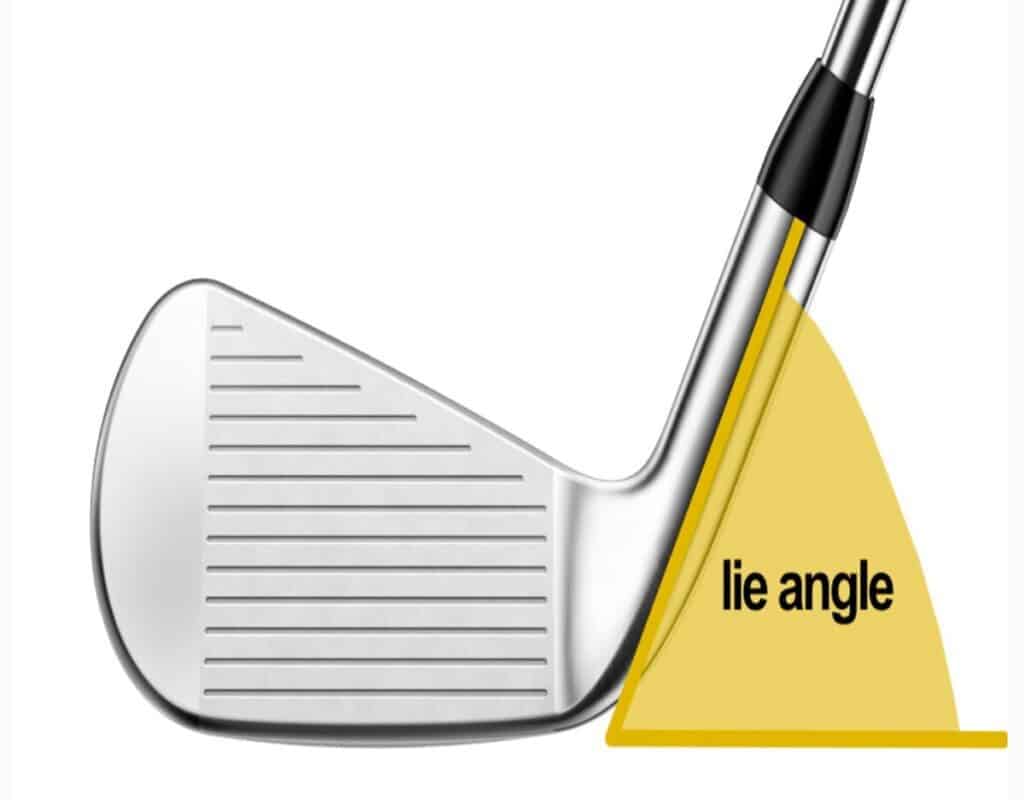
Lie angle matters because it influences how the sole strikes the ground — which affects strike and direction.
The simplest starting point (and what most fitters aim for) therefore is – Match wedge lie angles to your irons, so the clubs “sit” similarly at address and through impact.
All experienced fitters freqs a starting point simply getting the lengths, shafts and lie angles checked to see how different they are.
And as Nick Sherburne of Club Champion simply advises:
“… usually you want the same shaft, length and lie angle in your wedges as the irons to allow proper gapping. Most wedges off the shelf come with a shaft that for many golfers might be too heavy and stiff. Your wedges are extensions to your irons so they should 99 percent be set up the same for proper gapping and dispersion.”
Nick Sherburne, founder of Club Champion, a 100 Best Clubfitter
The main message
All experience fitters frequently tell stories of finding golfers who have never had any of these three components of their wedges checked and end up playing off-the-shelf lightweight 70-80 gram shafts in their irons but pro-version 120-130+ gram shafts in their wedges.
And they then wonder why they are not hitting their wedges well.
But after a simple test of shafts more aligned to their irons they suddenly find they can hit their wedges much better.
So wherever you are with your wedge choice get these three – shaft, length and lie angle – aligned first. Then you’ll actually be able to judge whether swapping bounces, grinds, brands, finishes etc makes any difference.
Do All the Pros Have Matching Wedges?
Plenty of amateurs buy wedges because a tour player uses them or copy their wedge set ups — which is understandable.
So do they all use the same wedges?
Golfing Focus does a yearly deep dive analysis into the wedges PGA players use and here’s a snapshot of how the wedge set up of some of the best in the business matches up.
| PGA TOUR PRO | WEDGE MATCH? | MAIN SPONSOR |
| Rory McIlroy | Brand match: Yes Model match: Yes Shaft match: Yes Bounce match: No Grind match: No | TaylorMade |
| Scottie Scheffler | Brand match: No Model match: No Shaft match: Yes Bounce match: No Grind match: No | TaylorMade |
| Justin Rose | Brand match: No Model match: No Shaft match: No Bounce match: No Grind match: No | Equipment free agent |
| Tommy Fleetwood | Brand match: Yes Model match: No Shaft match: Yes Bounce match: No Grind match: No | TaylorMade |
| Justin Thomas | Brand match: Yes Model match: No Shaft match: Yes Bounce match: No Grind match: No | Titleist |
| Viktor Hovland | Brand match: Yes Model match: No Shaft match: No Bounce match: No Grind match: No | PING |
So what does this all tell us, the lowly amateur?
Plenty of pros’ wedges do look be beautifully matched – same brand, even the same model – but look more closely and they clearly aren’t even in these cases.
Because the real takeaway is this – pros obsess over their wedge delivering predictable distance numbers across the variety of different around the green situations they find themselves in.
They don’t ‘match’ any wedge spec across their set up for the sake of it. And pros don’t just know one “full” number for each wedge.
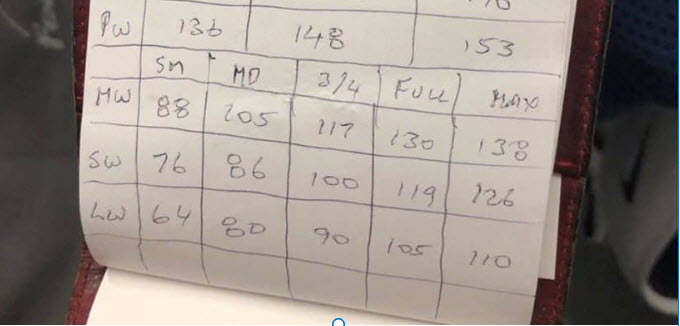
They have a stock yardage for full, ¾, half and a variety of different swings — because Tour golf is basically a constant stream of awkward in-between distances.
That’s why Brooks Koepka’s yardage book is such a great visual.
And to deliver those results – aside from the thousands of hours of practice they put in – they certainly don’t simply ‘standardise’ their wedge builds.
Wedge analysis from Golf.com makes this point well.
- There’s a 60/40 split on the PGA Tour between those who dropped to softer flex shaft wedges and those who kept the same flex of shaft as their irons.
- A proportion use wedges of all the same length as their short irons. Others use clubs that are 1/2 inch shorter than their irons. Another group make their wedges progressively 1/4 shorter.
As we can see from the above table also that none of the top pros opt for an entirely common bounce and grind set up across all their wedges.
And to add further complexity to the mix also many pros have ‘custom’ grinds on their wedges which are unique to them and you will not find in any pro shop.
Pros clearly change their wedge set ups whatever combination improves distance control, shot options and feel.
And only when ‘matching’ specific wedge specs delivers this will be they bother with it.
Before You Go ….
Nick Sherburne, founder of Club Champion and one of Golf Digest’s 100 Best Clubfitters says ‘your wedges are extensions to your irons so they should be 99% be set up the same for proper gapping and dispersion. So …
Should Your Wedges Match Your Irons?
Other articles related to this topic:
- How Far Should You Hit Your Wedges?
- Should You Have the Same Grips on All Your Golf Clubs?
- Should Your Driver Match Your Woods? Don’t Waste Your Money!
- Should I Play Blades or Cavity Back Irons? Use Your Head
- Are My Golf Clubs Too Old? It’s Performance Not Age That Matters
- How Much Does a Golf Club Fitting Cost? Is it Worth it?
- Can You Get Your Existing Golf Clubs Custom Fitted? Complexity = Cost
- Wedge Wizardry: What Wedges Do PGA Pros Use?
- The Wedge Report: What Wedges Do LPGA Players Use?
RECENT ARTICLES




LEGAL INFORMATION
This site is owned and operated by Golfing Focus Limited, a private limited company whose registered office is in London, UK. Golfing Focus Limited is a participant in the Amazon Services LLC Associates Program, an affiliate advertising program designed to provide a means for sites to earn advertising fees (at no cost to you) by linking to Amazon.com. Golfing Focus Limited also participates in other affiliate programs with the eBay Partner Network, FlexOffers, CJ.com, Svorn and other sites and is compensated for referring traffic and business to these companies (again at no cost to you).
Our Socials
Leave a Reply