
Hybrid Power: The Most Used Hybrids on the PGA Tour (2026)


When we covered what are the most used clubs the best pros on the PGA Tour we decided not to stop there.
We wanted to go deeper into the individual club types they are using so in this post we look at hybrids – the club that has proved to be the saviour for all standards of golfers (including the pros!) struggling to hit their long irons consistently well.
Golfing Focus has now run the study of the most used hybrids on the PGA Tour four times since 2021 and the latest numbers tell an interesting story.
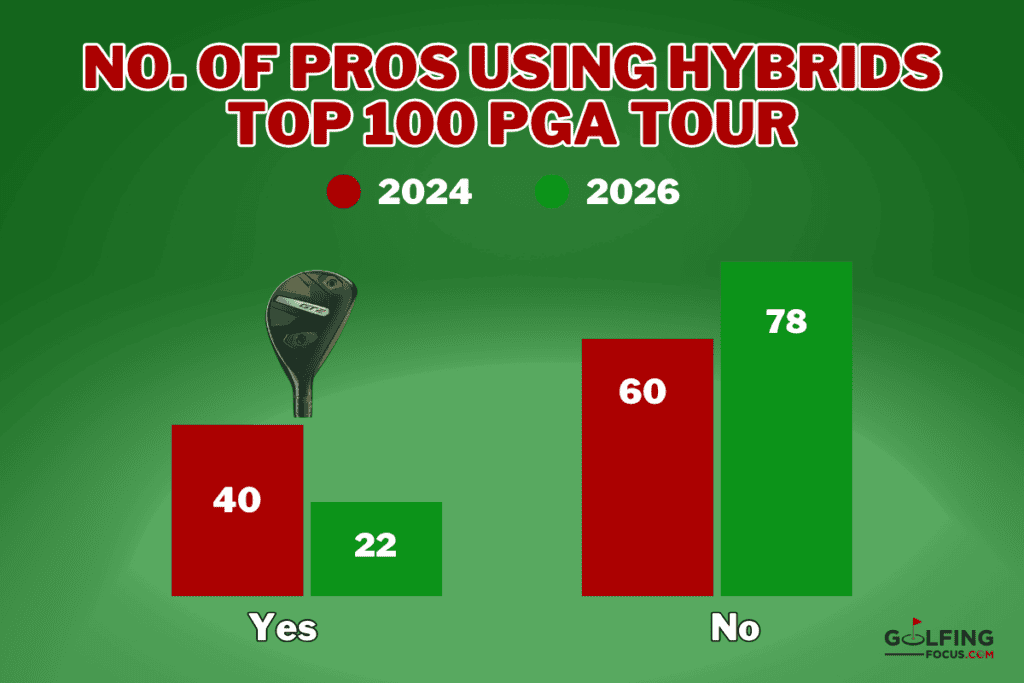
Just 13 of the top 100 now always carry a hybrid, with 9 more carrying one as part of an extended touring set (22 players total). That is nearly half the 40 players we found in our 2024 study. Callaway’s Apex UW remains the most used individual model among those who do carry one, with Titleist the dominant brand overall. Harry Hall was until recently the only player in the top 100 to carry two hybrids, a 17 degree and a 22 degree PING G430.
So should you take that as a signal to ditch your hybrids? Not quite.
As is the case with everything though when it comes to the pros the story doesn’t stop there.
A more in-depth look at what specific hybrids they use highlights the attention to detail that the best players put into selecting their clubs and why the pro trend tells one story, and the data for regular golfers another.
 Golfing Focused Takeaways For Time Pressed Golfers
- Just 13 of the top 100 PGA Tour pros always carry a hybrid (13%), down from 32% two years ago. 22 carry one in some form.
- Callaway’s Apex UW is the most used individual model; Titleist is the dominant hybrid brand overall.
- Hybrid usage on the PGA Tour has nearly halved, but it climbs to 74% on the Champions Tour and 70% on the LPGA, where swing speeds are closer to the average amateur.
- Hybrid lofts among the top pros range from 17 degrees to 24 degrees. The number on the clubhead matters less than the yardage gap it gives you.
- Arccos data from 200+ million shots: hybrid GIR% beats a 4-iron for every handicap bracket. Shot Scope finds amateurs hit greens from 200+ yards close to twice as often with a hybrid.
Most Used Hybrids on The PGA Tour – Top 100 Players Breakdown
When it comes to alternatives to long irons the pros have a few options whether that be a hybrid, a driving or utility iron or a higher-lofted fairway wood such as a 5-wood, 7-wood or even 9-wood.
Golfing Focus took a similar in-depth look at both the fairway woods (click here) and driving irons (click here) being used by the top 100 PGA Tour pros and those alternatives have been winning the argument lately.
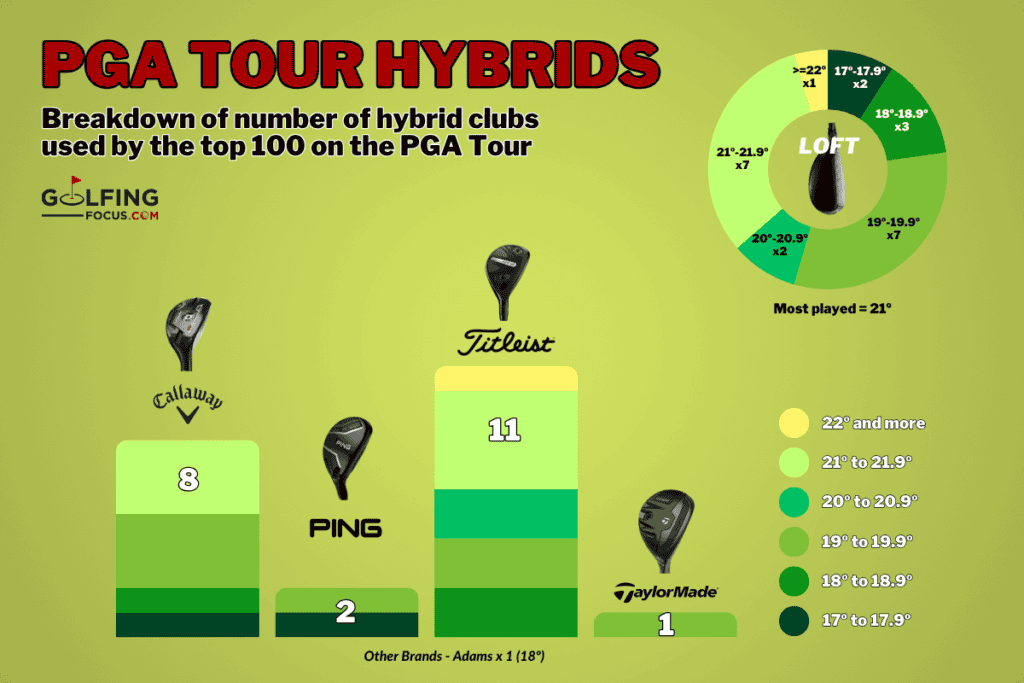
Among the 22 pros still carrying a hybrid in some form including as part of a wider set, Golfing Focus latest analysis uncovered 11 different models, down from 18 in our previous study.
The hybrid market among the top pros on the PGA Tour has clearly consolidated.
Titleist and Callaway remain the two dominant brands, with Players Championship winner and British Open runner-up Cameron Young carrying a Titleist GT3 during parts of the season.
World #5 Russell Henley meanwhile opted for a 21º Titleist TSi2 hybrid when winning the Charles Schwab Challenge.
Aaron Rai then used a 24º Titleist GT2 hybrid when winning his maiden major title at the 2026 USPGA at Aronnimink Golf Club in Pennsylvania.
Among the Callaway users, seven of the nine play the Apex UW, making it still the most used individual model among the top 100, ahead of the Titleist TSR2, chosen by five players.
It also worth noting though that of the four equipment ‘free agents’ – in other words the non-sponsored pros who are free to play whatever clubs they want – we uncovered to be using hybrids all of them chose Titleist hybrids.
In close to half the cases however, the hybrid is part of a wider set of 15 clubs with their hybrid and 5-wood or 7-wood interchanging depending on the tournament and course they are playing in any individual week.
That being said, while more often than not it is the case that the top pros will be choosing between adding a higher numbered fairway wood or driving iron to add to their bag in preference to a hybrid, it is not always a binary decision.
Further, the fact that of the 1/5 of the top 100 that still use hybrids either always or occasionally includes some of the very best players in the world – Russell Henley, Cameron Young and Aaron Rai – shows they are a potential option for anyone.

Check it out at the PGA Tour Superstore
[Note – Just so you know, and we are upfront as an affiliate program participant, Golfing Focus, at no cost to you, earns from qualifying purchases made through links on this page.]
Hybrid Lofts are Not All the Same Among the PGA Pros
One of the intriguing things when looking at the hybrids used by the best PGA pros is that there is no set loft attached to an individual number of hybrids.
While most tour players with hybrids in the bag will use them in place of a traditional 3-iron or 4-iron it is not simply a case of them automatically choosing an H3 or H4 hybrid.
In our look at why hybrids are easier to hit we give a guide of the degree ranges individual hybrids typically range from and to and the equivalent iron and wood they are intended to replace.
But there are no absolutely exact set of hybrid lofts that compare directly to irons and this is born out when you look at the hybrids used by the top 100 on the PGA Tour.
Golfing Focus’ analysis finds different pros using hybrids of loft 17 degrees – most closely aligned to a 2-iron or 4-wood loft – all the way up to 24 degrees, the loft of a normal 5-iron or 9-wood.
And while some of the top pros will take a 4-hybrid and bend the loft to the equivalent of a 3-hybrid others will do the reverse.
Among the top pros we even find hybrid lofts as precise as 19.7º, the loft of 2024 USPGA and British Open Champion Xander Schauffele’s Callaway Apex UW hybrid, which highlights the importance of not paying too much attention to the number on the hybrid itself.
The most important thing when it comes to hybrids is the distance and ball flight it delivers rather than the loft.
And each of these pros will spend a huge amount of time choosing a hybrid loft, rather than a hybrid number, to let them hit the ball:
- The yardage they want, with the correct gap to the clubs immediately above and below it in the bag, and
- With the ball flight they are targeting (i.e. ideal height and shape of shot via a draw or fade)
So if you are playing hybrids yourself – and we would recommend the vast majority of amateur golfers carry at least 2 if not 3 hybrids in their bag – it is worth paying attention to the ball flights and yardage gaps you hit between them rather than automatically swapping out your 2, 3 and 4-iron for example for a H2, H3 and H4.
Why Don’t More Pros Use Hybrids? Shaping Shots and Conditions
So if nearly a third of the top 100 were using hybrids two years ago and that number has dropped to 13%, what is actually driving the shift?
Why don’t more pros use hybrids?
The answer to that of course relates to personal preference but specifically what it typically comes down to is whether a player is prioritising being able to ‘work the ball’ over higher launch, spin and distance.
Long irons – and often utility/driving irons when it comes to the irons in the bag hybrids will typically replace – are frequently preferred by pros who like to be able to draw the ball right to left or fade it left to right when they choose to (i.e. ‘work the ball’).
With their increased thickness and centre of gravity further back from the clubface hybrids are not as effective in letting even the best players do that so some pros will choose long irons over hybrids on that basis.
“Since manufacturers started releasing specialist driving iron style clubs in 2014, these have since been fine-tuned in terms of centre of gravity and launch to provide a very similar offering to a hybrid, but in a more compact and workable profile. For pros who want that workability, there is now one more additional improved option than there used to be. And we can clearly see the impact of that in the latest hybrid usage numbers.”
Joe Ferguson, PGA professional and custom fitter who headed up national fitting centres for both Titleist and TaylorMade
In short: it is not that hybrids have gotten worse. It is that utility irons have gotten better.
But it is still not a straightforward decision, even at the top of the game. That is the part worth paying attention to.
For his 2024 USPGA win at the sun baked Valhalla Golf Club in Kentucky for example Xander Schauffele stuck with his trusty 19.7º (bent from 21º) Apex UW hybrid.
But in the blustery and wet conditions at the British Open at Royal Troon, he swapped out his hybrid in preference for a Mizuno MP-20 HMB 3-iron to ‘work the ball’ through the strong winds to win the claret jug.
And that change to a utility iron away from hybrid continues to be one Schauffele only makes during this European event rotation each year.
With their lower lofts and forward centres of gravity also long irons are correspondingly not as effective as hybrids or higher-numbered fairway woods in letting players hit the ball high.
And that can be a major problem on firmer courses where the pros need to be able to launch the ball high with high spin rates to hold very fast greens on a long par-3 or two-shot par-5.
To solve this pros will most often either opt for a high lofted fairway wood or hybrid and as the numbers show, more among the top 100 prefer the fairway woods options.
The reasons for that are again often related to personal preference.
A hybrid has the distance capabilities of an iron, but the ease of flight and the dynamics of the way a wood plays … so, there’s a combination of a lot of different things which is making them easier to hit.
Former World Club-Maker of the Year Derek Murray of Fore Golf
But more precisely it can be because higher swing speed players, which the top pros are, often find hybrids make the ball turn left due to their slight draw bias as a result of them having more weight in the heel of the club.
Higher lofted fairway woods by comparison will be more neutral at impact due to their larger heads and so will go straighter which pros can prefer, especially off the tee.
Hybrids are not dying out entirely on tour. But the situations where pros choose them seem to be narrowing.
What is noticeable too is how fast the change has come in recent times.
And that raises a question worth thinking about: if the world’s best ball-strikers are seemingly walking away from hybrids, should you?
[Editor’s note – Are you surprised by how many PGA Tour pros use a hybrid? Does it make you think you should be choosing to play one yourself if you don’t already? We’d love to hear your thoughts in the comments at the end of this post!]
Before you go …
Here is what the headline numbers do not tell you: the pro trend away from hybrids is almost entirely irrelevant to most regular golfers.
Everything we have just covered (the workability preference, the draw bias concern, the shift towards utility irons) is based on players swinging a hybrid at around 102 mph and a 3-iron at 100 mph. At those speeds, the differences between clubs are real and the trade-offs matter.
The average male amateur is a different story.
Swing speeds for a typical mid-handicapper sit closer to 87 mph with a hybrid and around 82 mph with a 4-iron. That puts most amateurs much closer to the swing speed profile of an LPGA Tour pro than a PGA Tour pro.
And it seems the top players on the LPGA Tour, and Champions Tour too, are much more willing than their PGA Tour colleagues to embrace the benefits of hybrids – one of the great success stories of golf club designers over the last number of years that has helped ease the pain of long shots for all standards of players.
So check out our similarly in-depth looks at the hybrids the best senior and women pros are using.
Champions Hybrid Heroes. Most Used Hybrids By Champions Tour Pros
Do LPGA Players Use Hybrids? They Have Many in Hand
Other top posts related to this topic:
- Gear Up: Uncovering The Most Used Clubs On The PGA Tour
- Driving For Dough! The Most Played Drivers On The PGA Tour
- Exploring The Fairway Woods The Best PGA Tour Pros Use
- Do Pros Carry a Driving Iron?
- A Deep Dive Into the Most Used Irons on the PGA Tour
- Wedge Wizardry: The Most Used Wedges on the PGA Tour
- What Putters Do Most PGA Players Use To Master the Greens
- Spotlight On The Most Popular Shaft On the PGA Tour
- Getting a Grip On the Most Popular Grips on the PGA Tour
- On The Ball: The Most Used Ball on the PGA Tour
- Do Pros Use Regular or Stiff Shafts?
- Do Pros Use Graphite or Steel Shafts?
- In The Bag: Unpacking The Clubs Champions Tour Players Use
- The Complete Guide To The Most Popular Clubs On LPGA Tour

RECENT ARTICLES





LEGAL INFORMATION
This site is owned and operated by Golfing Focus Limited, a private limited company whose registered office is in London, UK. Golfing Focus Limited is a participant in the Amazon Services LLC Associates Program, an affiliate advertising program designed to provide a means for sites to earn advertising fees (at no cost to you) by linking to Amazon.com. Golfing Focus Limited also participates in other affiliate programs with the eBay Partner Network, FlexOffers, CJ.com, Svorn and other sites and is compensated for referring traffic and business to these companies (again at no cost to you).
Our Socials
Leave a Reply