
A Deep Dive Into the Most Used Irons on the PGA Tour (2026)


I am in the process of changing my irons but before finalising my choices after testing out a bunch of the latest models I thought it would be interesting to take a look at the iron setups of the best players on the PGA Tour to see what they are playing with.
So we took a look at all the irons the top 100 PGA Tour players use, uncovered the most used iron brand and most popular irons on Tour, found out how many of the pros use blades or cavity backs before finally seeing what’s been changing each since we started this analysis a few years back.
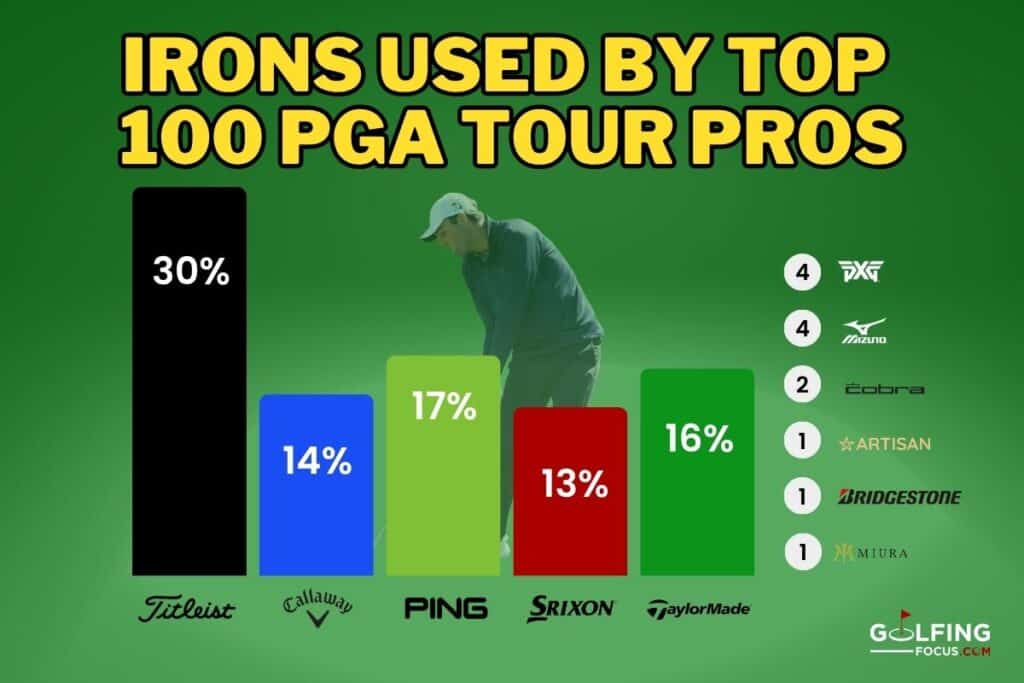
And as a whole Titleist are the most used brand of irons by the top 100 on the PGA Tour in 2026 with 30% playing them. PING irons have climbed to second with 17%, TaylorMade have jumped to third with 16% — up from just 6% in our 2024 study — with Callaway at 14% and Srixon at 13%.
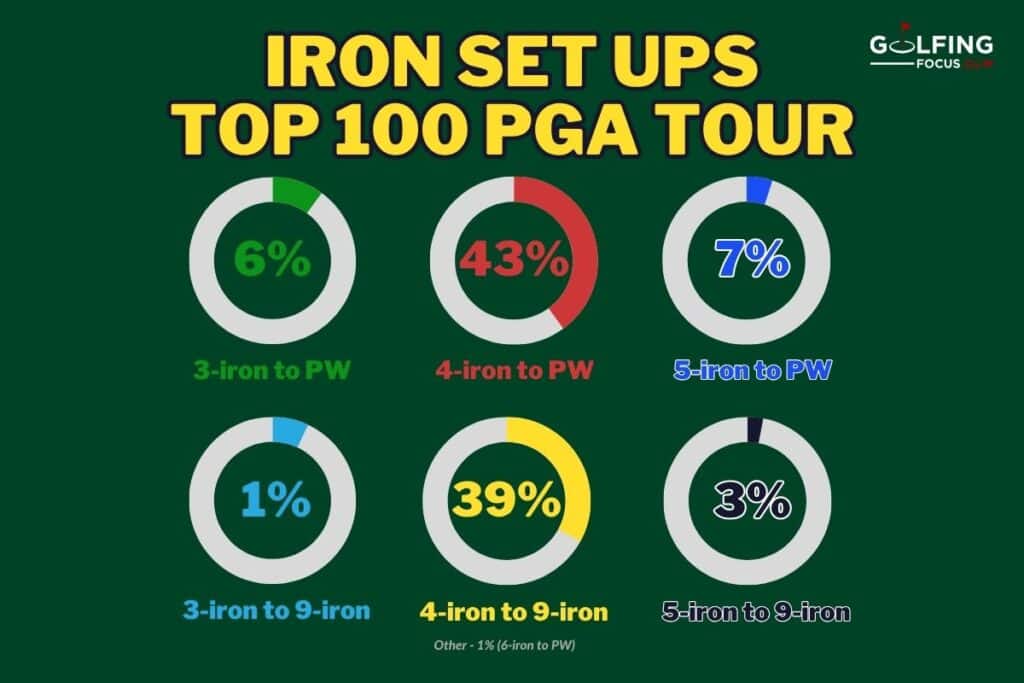
And ignoring utility irons the most common iron set-up played by 43% of this elite group is 4-iron to pitching wedge.
Golfing Focus’ detailed analysis of the iron set ups of the best Tour players has formed part of our overall look at the most used clubs on the PGA Tour and what is very clear when it comes to their irons is that there is no such thing as a ‘standard’ set.
Because the world’s best players are always aiming to find whatever advantage they can they are constantly experimenting with those options to find the best combination that suits both their game and the particular course they are playing on any given week.
The days of every pro having a 3-iron to pitching wedge as ‘standard’ are certainly long gone and what is very apparent in the modern game is that the top players are getting closer to almost choosing each iron individually and not as a set!
 Golfing Focused Takeaways For Time Pressed Golfers
- Titleist remains the most-used iron brand on the PGA Tour with 30% of the top 100, but their lead has shrunk — TaylorMade have tripled their share from 6% to 16% in two years.
- The Titleist T100 is still the single most-used iron model, carried by 22 of the top 100.
- 58% of the top 100 now play a ‘mixed’ iron set — two or more different iron models in the same bag.
- Among the 19 players with no iron endorsement deal, TaylorMade is the most common choice — previously Titleist dominated this group.
- Blades are not dying out. Pure-blade use has bounced back to 16 players after dipping in our 2024 study.
The Most Popular Irons On The PGA Tour. How The Brand Rankings Changed In 2026
Analyzing the iron setups of the pros is not as straightforward a task as it used to be.
And the simple reason for that is that there are now so many more options for golfers when it comes to making up their set of irons and clubs in general.
Many of the top PGA Tour players are now carrying hybrids or 5-woods, 7-woods or even 9-woods in preference to long irons while others are opting for utility/driving irons.
So for some Tour pros today their ‘standard’ iron set is starting with a 5-iron or even a 6-iron in the case of Brian Harman!
Irrespective of this Golfing Focus took on the challenge and was able to put together a complete breakdown of the irons used by the top 100 players on the PGA Tour to find out what the most used irons are among this elite group.
Titleist’s T100 irons remain the single most-used iron model on the PGA Tour with 22 of the top 100 carrying at least one T100 as part of their set. PING’s Blueprint S and T variants account for 9 bags combined, matching the Srixon ZX5 + ZX7 pairing which has emerged as the most common mixed-set combination on Tour.
TaylorMade’s P790 features in 7 bags and Callaway’s Apex TCB in 7 more — both more than in our previous study.
This is the fourth year Golfing Focus has done this deep dive into the iron choices of the top 100 PGA Tour pros and the 2026 data reveals some of the most significant brand shifts we’ve seen.
Titleist remain the most-used brand but their share has dropped from 37% in 2024 to 30% this year. PING have moved up to second at 17%, and TaylorMade have made the most dramatic jump — from 6% in our 2024 study to 16% — leapfrogging Callaway to take third.
The top 100 are now using 11 different brands and 59 individual models, up from 10 brands and 53 models in our last study.
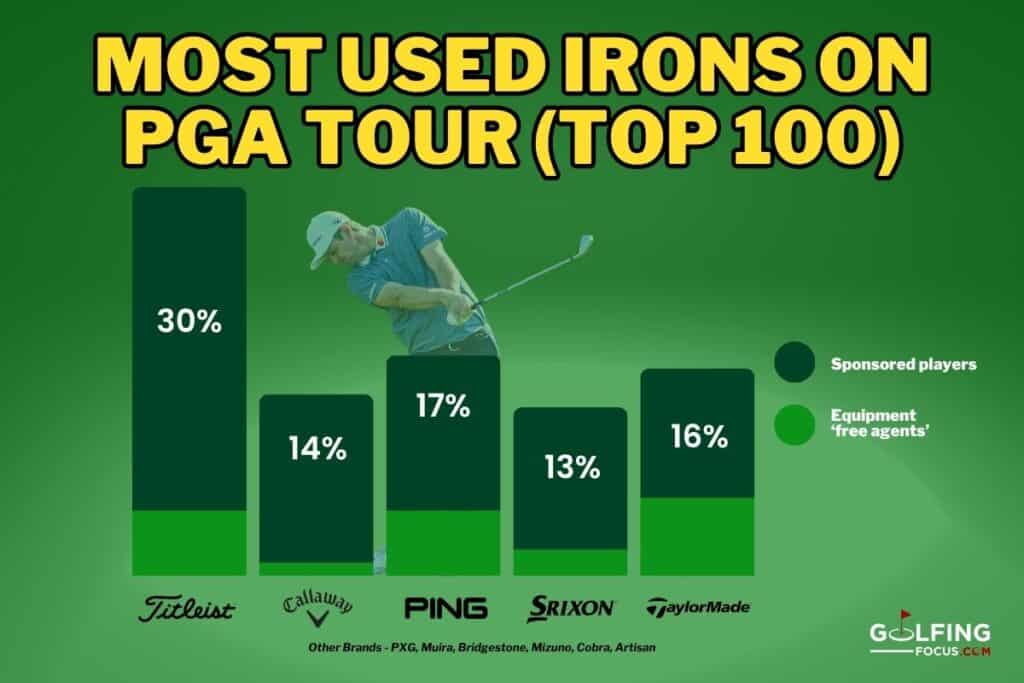
But a comment we here often is that Titleist are only the most used irons on the PGA Tour because they have the most sponsored players on their books.
Endorsement deals undoubtedly play a big part in professional golf and many pros are indeed paid large sums of money to use a particular brand of irons.
That being said there are a number of equipment ‘free agents’ in our top 100 study – Jason Day, Adam Scott and Patrick Cantlay etc – who have the flexibility to play whatever irons they choose.
And in an interesting twist, our 2026 research found that TaylorMade is now the most popular choice among this unsponsored group, with Titleist and PING tied behind them.
Two years ago Titleist dominated this same group with 50% of free agents playing them. The shift suggests TaylorMade’s product line — and the P790 in particular — is earning genuine, unsponsored endorsement from elite-level players in a way that hasn’t been seen before.
Mixed Iron Sets Are Now Dominant on the PGA Tour – Top 100 Player Breakdown
If there’s one pattern that stands out from our years of tracking the top 100 PGA Tour pros’ iron setups, it’s this: the standard matched set is effectively dead at elite level.
This leads some not only to test out and switch to the latest models of their current irons, or entirely different sets of irons, but also to players such as Patrick Cantlay getting custom grinds on the leading edges of their irons to achieve the precise turf interaction at impact they want.
Matt Fitzpatrick meanwhile switched away from his 2022 US Open winning PING s55 irons to a set of T100 irons for a spell because alongside his switch from a 2019 Titleist ProV1x to the latest version they gave him ” … a little bit more flight and a little bit more spin.“
He’s now switched back again though to his trusty s55’s and it seems to have done the trick given his three PGA Tour wins in 2026.
Others prefer to stick with an iron model once they find one they like and that can mean sticking with a model of irons that were released many years previously.
Adam Schenk for example plays with a set of 2017 Mizuno MP-18 irons alongside his 2017 PING G400 driver.
Despite all this tinkering and testing by the top PGA Tour pros however Golfing Focus’ yearly deep dives into the most used irons on the PGA Tour has thrown up a clear trend amongst the top 100 players.
And that is the ‘mixed set’ of irons that many are now choosing to use.
It is therefore important we consider this in the context of looking at the topic of the most used irons on the PGA Tour.
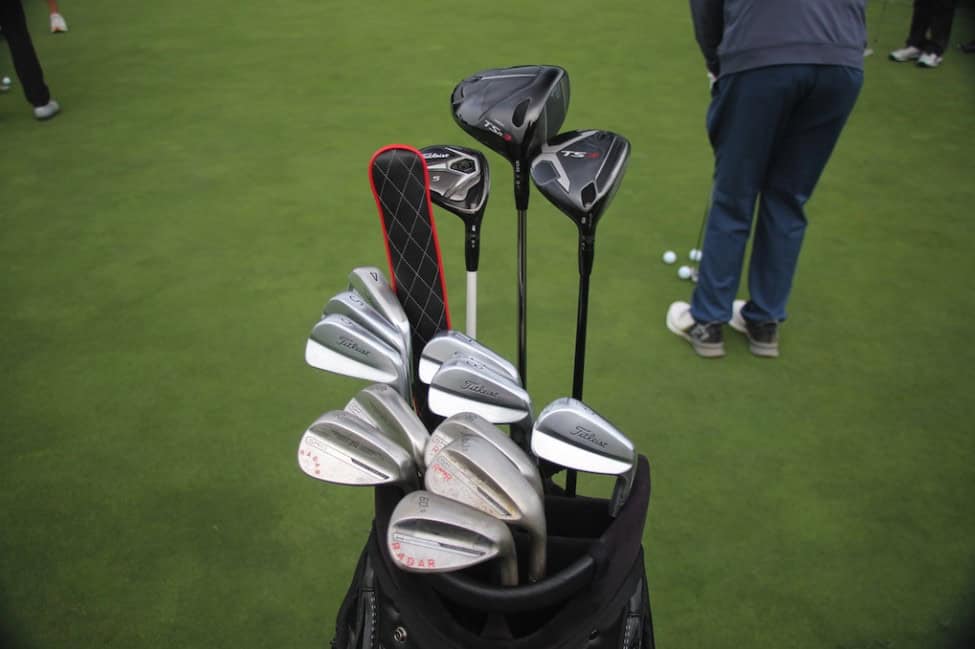
Because while Titleist’s T100 may indeed be the most common iron model among the top 100 certain players like Tom Hoge are only using one individual T100 iron before switching to different models for the remainder of their iron sets up to pitching wedge – a 4-iron T100 and 5-to-9-iron 620 MB’s in Hoge’s case.
In 2021 Golfing Focus uncovered 27% of the top 100 PGA Tour pros opting for a ‘mixed set’ of irons where they use more than one iron model.
In 2023 we found 42% of this elite group doing so but today we discovered that percentage has risen again to a whopping 58% of the top 100 opting for a ‘mixed set’ of irons.
And of that 58% five players, including Cameron Young, Justin Thomas, Denny McCarthy, Thomas Detry and Steven Fisk, each use three different models of irons in their set ups from 3 or 4-iron up to 9-iron or pitching wedge.
[Credit: Golf WRX]
As a result, Golfing Focus found the top 100 PGA Tour pros using 11 different brands and 59 different individual models of irons in total from all the top manufacturers including Titleist, Callaway, TaylorMade, Srixon and PING to newer and smaller golf brands such as PXG, Mizuno, Cobra, and Miura.
And if you’re thinking of building a mixed set yourself, the most common pairing in the top 100 is instructive: nine players combine Srixon ZX5 long irons with ZX7 short irons.
The logic is straightforward — the more forgiving ZX5 for the longer, harder-to-hit clubs, the more workable ZX7 where precision matters most. It’s the same principle almost all mixed-set players follow, regardless of brand.
We can therefore again see that the question about what are the most used irons on the PGA Tour is not as clear cut as it once was. As also is the question of whether pros use cavity backs or blades which we cover in more detail below.
When you then add ‘driving’ or ‘utility’ irons into the picture too the idea of the ‘mixed/combo’ set becomes even more evident as in addition to the 58% of the top 100 we noted who play with a mixed set of ‘standard’ irons a further 23 players, add a 2, 3, or 4 utility iron to their bag.
The dominant pattern is consistent: cavity-back or players-distance iron for the long irons (typically 4 through 6), transitioning to a blade or players iron from the mid-irons down. It’s an approach that prioritises launch and forgiveness where it’s hardest to achieve, and control where it matters most.
[Editor’s notes 1. hollow’ head/body irons have an ‘internal cavity’ to remove inefficient weight and therefore increase forgiveness without the need to make the club head the size of a large cavity back. 2. And do you use a mixed set of irons yourself? Are you considering changing to a mixed set? Get involved and let us know in the comments below! ]
So if we consider driving irons as ‘standard’ irons we could argue that over 3/4 of the top 100 players on the PGA Tour opt for a ‘mixed set’ of irons.
Golfing Focus puts driving/utility irons in a comparative bucket with hybrids and high-numbered fairway woods – and you can see what PGA players use utility irons here – but what is also fascinating to see among the best players on Tour is the multiple different combinations of irons they carry in their bag.
While 6% of the top 100 on Tour stick with the traditional 3-iron to pitching wedge iron setup, including Sam Stevens, there are two more popular setups within this elite group.
Tommy Fleetwood is among the 43% of the top 100 on the PGA Tour who prefer to start their iron set with a 4-iron through to a pitching wedge while 39%, including Rory McIlroy and Cameron Young, choose instead to use a 4-iron through to only a 9-iron before switching to specialist wedges.
These percentages are up on a few years ago so it seems an increasing number of the best pros on the PGA Tour are settling on one of these two iron set ups.
The chart below shows the full range of iron set ups currently being used by the top 100 on the PGA Tour which interestingly also includes a few anomalies.
Former British Open Champion Brian Harman for example doesn’t start his ‘traditional iron set until a 6-iron choosing a 4 and 5-iron Titleist U-500 driving iron.
World no.1 Scottie Scheffler meanwhile opts to play not just one but two Srixon Z U85 driving irons before he joins a minority of the top pros who start their main iron set with a 5-iron.
Taking all this into account one thing seems crystal clear therefore when looking at the iron set ups of the top 100 players on the PGA Tour.
There is no longer such a thing as a ‘standard’ set of irons.
Do Any Pros Use Blades or Cavity Back Irons? The Real Split
Because the best pros in the world are so good many amateurs often assume that the vast majority must use blade irons.
For as long as I can remember blade irons have been seen as a right of passage for better players and once a golfer had reached a certain standard they would graduate from cavity back irons to blades.
Looking in detail at the iron set ups of the top 100 pros however it is clear that such a view is a long way from reality when it comes to the kind of irons PGA players play.
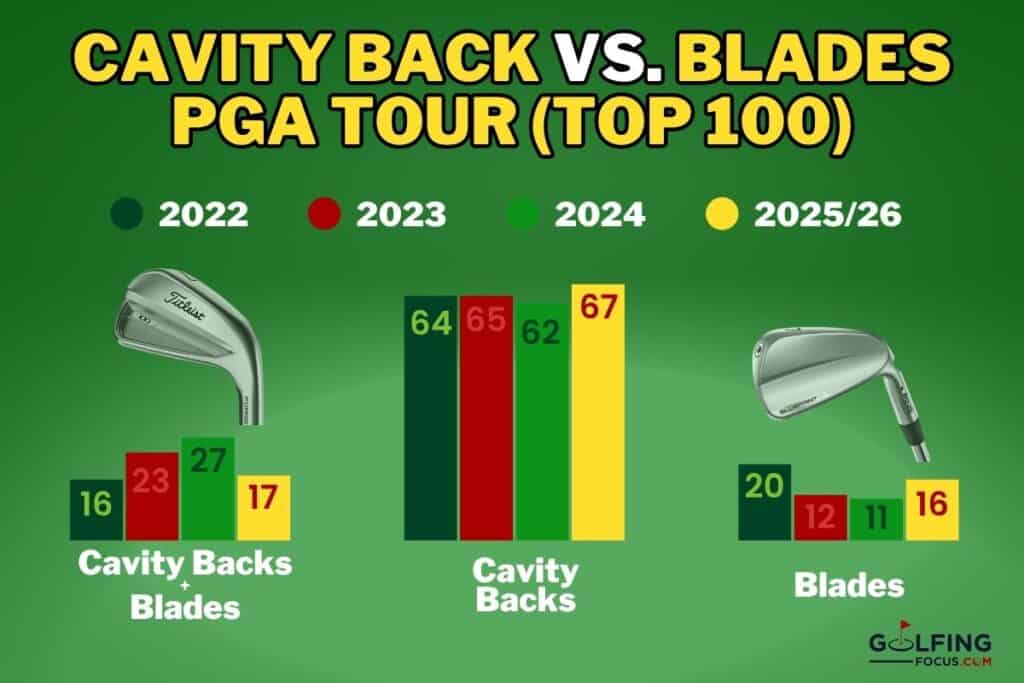
67% of the top 100 PGA Tour pros use cavity backs and that number rises to 79% when taking into account the players who use at least one cavity back iron in their mixed set.
Based on these numbers therefore it seems the majority of even the best players in the world choose the extra forgiveness and distance which is afforded to golfers using cavity back irons.
“I joke around, ‘I’m not good enough to play the blades,’ but in reality, I think we’re just being smarter. I think we’re just like, ‘Oh, we can actually hit every shot that a blade can hit.’ But that chance that we mishit them – which we’re going to mishit a few shots in a round, even in a great round, the idea that it does carry that bunker and you make birdie on a hole where someone has to get up-and-down for par – I mean, it could be the difference in a tournament.”
Jordan Speith, 3-time major champion
What’s interesting about our 2026 data however is that the blade decline we’d tracked in previous years has reversed slightly.
The number of top-100 players using only blade irons has risen from 11% in our 2024 study back to 16 players — suggesting that for some of the very best players, the control and feedback of a blade remains hard to give up despite the forgiveness benefits of cavity backs.
The tension between blade feel and cavity-back forgiveness was illustrated perfectly by Rory McIlroy at the start of 2026.
McIlroy — who normally plays TaylorMade’s P730 Rors Proto blades — briefly switched to the more forgiving TaylorMade P7CB cavity backs in an attempt to find more consistency. The experiment lasted less than a month before he reverted to his blades.
It’s important to note also when it comes to the blades being used by the top pros today modern iron technology means that these irons are a far cry from the ‘blades’ of years past.
Blades then would look no thicker than a knife and give your hands a ‘sting’ on a cold day when not hit correctly out of the middle of the face.
Huge advancements in golf tech have meant that many of today’s ‘blade’ irons are more forgiving and closer to a cavity back iron than they used to be with the result that the distinction between the two club types is no longer as clear as it once was.
By putting more metal behind the hitting zone golf club designers are now creating ‘blades’ which have picked up the nickname of ‘muscle back’ irons.
So when you hear people talking about ‘blades’ nowadays it is likely that they are talking about ‘muscle back’ irons which are a bit away from the thin pieces of metal that were called ‘blades’ back in the day.
That is not to say that there are still some very traditional blades around being used by some of the best iron players on Tour – Taylor Made’s P7TW’s being played by Scottie Scheffler and Tommy Fleetwood are a great example.
It is just that they are not used by a lot of players and when it comes to the longest irons in particular very few of the top 100 pros on Tour today are prepared to use blades.
World No.1 Scottie Scheffler, the best iron player on Tour by a distance at the moment, may use very unforgiving P7TW blade irons for the main part of his set from 5-iron to pitching wedge.
But as we’ve already noted when it comes to his 3-iron and 4-iron he is more than happy to go with the much greater forgiveness offered by Srixon’s Z U85 cavity-backed driving irons.
And he’s not doing too badly as a result!
That being said if we break down iron categories again and use Today’s Golfer‘s superb and detailed classification of the iron types available on the golf market today it is obvious that the top pros are very much the elite ball strikers in the game.
Over 70% use at least one blade iron or what are known as ‘Players Golf Irons’. This is a ‘category of iron that is a ‘cavity back’ and although not quite as small and thin as blades don’t offer much more forgiveness.
However when we look at all the irons in all the mixed sets of the top 100 PGA Tour pros a good number are happy to embrace the increased forgiveness, ball speed and distance that ‘Players Distance’ or Mid-Handicap irons offer.
Mid-Handicap, or ‘game improvement’ irons as they are also known are the most sold in the general golf market and are ones with which regular golfers will be most familiar.
Takumi Kanaya is even happy to embrace the benefits of a PING ‘super’ game improvement G710 5-iron and our analysis also highlights that over a quarter of the top 100 PGA Tour pros are using at least one ‘Players Distance’ iron in their bag.
So it seems fair to say, and especially when it comes to the long irons, the best players in the world are like us lowly amateurs looking for a bit of extra forgiveness.
Before you go …
If you also want to know what iron shafts the top PGA Tour pros are choosing to put in their irons check out our comparative deep dive into the what’s the most used iron shaft on the PGA Tour.
What’s The Most Popular Shaft On The PGA Tour
Or if you are wondering how the iron choices of the PGA Tour pros compare with those of the best women and senior pros check out our studies of the irons they are using below.
Champions’ Choice: The Most Used Irons on the Senior Tour
Perfecting The Approach: The Most Popular Irons On LPGA Tour
Other top articles related to this topic:
- Gear Up: Uncovering The Most Used Clubs On The PGA Tour
- Driving For Dough! The Most Played Drivers On The PGA Tour
- Exploring The Fairway Woods The Best PGA Tour Pros Use
- Hybrid Power: The Most Used Hybrids on the PGA Tour
- Do Pros Carry a Driving Iron?
- A Deep Dive Into the Most Used Irons on the PGA Tour
- Wedge Wizardry: The Most Used Wedges on the PGA Tour
- What Putters Do Most PGA Players Use To Master the Greens
- Spotlight On The Most Popular Shaft On the PGA Tour
- Getting a Grip On the Most Popular Grips on the PGA Tour
- On The Ball: The Most Used Ball on the PGA Tour
- Do Pros Use Regular or Stiff Shafts?
- Do Pros Use Graphite or Steel Shafts?
- In The Bag: Unpacking The Clubs Champions Tour Players Use
- The Complete Guide To The Most Popular Clubs On LPGA Tour

RECENT ARTICLES





LEGAL INFORMATION
This site is owned and operated by Golfing Focus Limited, a private limited company whose registered office is in London, UK. Golfing Focus Limited is a participant in the Amazon Services LLC Associates Program, an affiliate advertising program designed to provide a means for sites to earn advertising fees (at no cost to you) by linking to Amazon.com. Golfing Focus Limited also participates in other affiliate programs with the eBay Partner Network, FlexOffers, CJ.com, Svorn and other sites and is compensated for referring traffic and business to these companies (again at no cost to you).
Our Socials
Leave a Reply