
The Distance vs Accuracy Golf Debate Is Over According To The Data


Picture this: You’re on the first tee watching two golfers.
One smashes it 280+ yards but sprays drives all over the place. The other hits it 200 yards but splits every fairway.
Which one’s going to post the better score?
The question of what’s more important in golf – distance or accuracy – has been wrestled over and argued amongst golfers for years and years.
And based on Arccos’ analysis of millions of their users drives it appears we have a clear answer – distance has a significantly greater impact on scoring than accuracy.
While better golfers do hit more fairways than higher handicappers, the accuracy gap is surprisingly small compared to the massive distance advantages that directly correlate with big differences in greens-in-regulation percentages and overall scoring.
That being said golf as we all know is never totally black and white.
So let’s dive deep into the numbers to settle this distance vs accuracy golf debate once and for all!
 Golfing Focused Takeaways For Time Pressed Golfers
- Distance beats accuracy for scoring at every handicap according to the data (Arccos & Shot Scope).
- Accuracy gap is small between different standards of golfer: better players hit only a few more fairways per round than 30+ handicappers.
- But the distance gap between low and high handicappers is huge: this leads to shorter approach shots driving higher greens in regulation and lower scores.
- Age trade-off: you’ll hit more fairways as you age—but you should work to protect the distance you have.
- Practical choice: as much as possible hit driver off the tee; laying up ‘for accuracy’ with fairway woods and hybrids costs strokes on average.


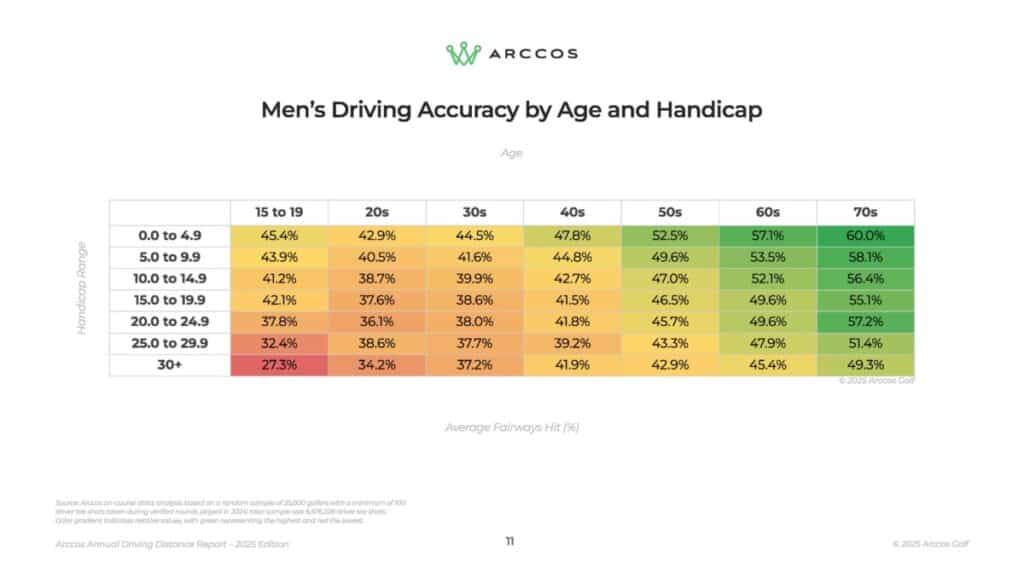
What The Numbers Show About The Distance vs Accuracy Debate
Get a group of amateur golfers in a room and you will quickly find defenders of both sides of the debate on whether distance or accuracy is more important in golf.
And for some, not even Arccos’ latest analysis of close to 7 million tee shots – hit by a random sample of 25,000 golfers on par 4s and par 5s only – will convince them of the opposite point of view.
Many naturally assume for example that better players are much more accurate off the tee. Well, yes and no.
Golfing Focus’ deep dive research into Arccos’ Driving Report highlights that while scratch golfers do hit more fairways than higher handicappers, the gap is much smaller than you’d expect.
Scratch to 4.9 handicap index male amateurs for example hit only 8.7% more fairways than their 30+ index friends – 49.3% vs. 40.6%.
On a typical golf course with four par 5s and ten par 4s that’s only 1 more fairway hit per round!
And for perspective, PGA Tour pros hit an average of around 59% of fairways. And remember, these are the world’s best players.
| HANDICAP RANGE | DRIVING ACCURACY (MEN) AVERAGE FAIRWAYS HIT | DIFFERENCE |
| PGA Tour | 59% | – |
| 0 to 4.9 | 49.3% | 9.7% |
| 5 to 9.9 | 47.1% | 2.2% |
| 10 to 14.9 | 45.3% | 1.8% |
| 15 to 19.9 | 44% | 1.3% |
| 20 to 24.9 | 43.4% | 0.6% |
| 25 to 29.9 | 41.5% | 1.9% |
| 30+ | 40.6% | 0.9% |
But here’s where the real insight from the Arccos numbers comes in.
Distance differs far more dramatically between skill levels.
| HANDICAP RANGE | AVERAGE TOTAL DRIVING DISTANCE (MEN) | DIFFERENCE |
| PGA Tour | 303.7 yards | – |
| 0 to 4.9 | 250 yards | 53.7 yards |
| 5 to 9.9 | 236.6 yards | 13.4 yards |
| 10.0 to 14.9 | 224.7 yards | 11.9 yards |
| 15 to 19.9 | 212.3 yards | 12.4 yards |
| 20.0 to 24.9 | 202.9 yards | 9.4 yards |
| 25 to 29.9 | 196.1 yards | 6.8 yards |
| 30+ | 184.9 yards | 11.2 yards |
That’s a 65.1-yard gap between scratch golfers and 30+ handicappers. 47.1 yards further than 20 handicappers.
I’ll be honest – when I first saw this data and looked at these numbers in-depth, I had to double-check it. But there it was, clear as day.
Better players do hit more fairways, but the distance advantage is where the real separation happens.
For pros driving distance is more important than driving accuracy. For amateur golfers, driving distance is even more important for scoring than driving accuracy.
PROFESSOR Mark broadie, AUTHOR Of EVERY SHOT COUNTS AND pioneer of modern golf stats and the strokes gained metric
The Scoring Impact: Where Distance Wins The Day
If we then turn to greens-in-regulation data here’s where we can answer what’s more important in golf, distance or accuracy with yet more informative numbers.
| HANDICAP – MEN | GREENS IN REGULATION (GIR) | GIRs PER ROUND |
| PGA Tour | 66% | 12.1 |
| Scratch | 56% | 10.1 |
| 3 Handicap | 50% | 9 |
| 6 Handicap | 44% | 7.9 |
| 9 Handicap | 38% | 6.8 |
| 12 Handicap | 31% | 5.6 |
| 15 Handicap | 27% | 4.9 |
| 18 Handicap | 23% | 4.1 |
| 20 Handicap | 20% | 3.6 |
So scratch golfers hit nearly 3 times more greens in regulation than 20 handicappers.
Let that sink in for a moment.
When you’re putting for birdie 10 times per round instead of three or four times, the scoring advantage becomes obvious.
But that’s just part of the approach shot story – when scratch golfers do hit greens, they’re 10 feet closer to the pin on average (26ft vs 36ft).
And here’s where it gets really interesting – this Arccos data is backed up by research of Shot Scope‘s database of over 200 million shots.
Their study looked at a specific scenario:
- A 395-yard par-4
- Scratch golfers drives 260 yards leaving 135 yards for a 9-iron approach
- 20 handicapper driving 204 yards leaving 191 yards requiring a 3-wood
The results?
The scratch golfer hit the green 62.5% of the time, while the 20-handicapper managed just 7%.
That’s a staggering 55.5 percentage point difference on a single hole type.
Two completely different data sources, same conclusion: distance creates a massive advantage in greens-in-regulation performance.
And the progression is remarkably consistent – every 3-handicap improvement correlates with roughly 5-6 percentage points better GIR performance.
This isn’t coincidence. It’s the direct result of those distance advantages translating into easier approach shots.
And here’s the added bonus: gaining distance isn’t isolated to just your driver.
If you gain 10 yards with your driver, you’ll likely hit your other clubs further as well, compounding the advantage throughout your bag!
So the maths is clear – adding distance is more likely to improve your scores than losing distance is to hurt them.
The more conservative strategy is not the same as the optimal strategy. On most holes choosing an iron off the tee instead of a driver gives away strokes
Professor Mark Broadie, Pioneer of the strokes gained metric first adopted by the PGA Tour in 2011
Age, Distance, And The ‘Distance Dilemma’
Now, if you’re reading this thinking “Great, but I’m not getting any younger,” I hear you.
The data has some important insights for us more, shall we say, experienced golfers.
| AGE GROUP | AVERAGE TOTAL DRIVING DISTANCE (MEN) | AVERAGE FAIRWAYS HIT (MEN) |
| 20s | 240.4 yards | 39% |
| 30s | 238.1 yards | 40.4% |
| 40s | 232.1 yards | 43.6% |
| 50s | 220.7 yards | 48.1% |
| 60s | 208.6 yards | 52.1% |
| 70s | 190.5 yards | 56.5% |
And the simple straight forward message is this – as golfers age and lose distance, their accuracy improves.
Players in their 70s for example hit 17.5 percentage points more fairways than those in their 20s – in more useful and practical terms two or three a round. Yet they’re still hitting it 49.9 yards shorter on average,
And this creates what I call the “Distance Dilemma.”
Should you prioritise accuracy more than distance as your physical capabilities start naturally to decline?
The natural aging process forces golfers to choose between power and precision, and the data suggests that maintaining distance should be the priority for as long as possible.
So here’s our take – even if you’re not 25 anymore, working on at least maintaining distance will have a bigger impact on your scores than perfecting your accuracy.
Consider this: a 50-year-old golfer hitting 215 yards hitting 47% of fairways is still going to struggle more than a 40-year-old hitting 235 yards with 42% accuracy.
Why? The shorter club selection advantages that extra distance provides.
I’m curious – does this data change how you’ll approach your game? Are you team distance or still betting on accuracy?
Let us know in the comments 👍
What This All Really Means For Your Game
So is distance the most important thing in golf?
The answer is more nuanced than a simple yes or no.
Distance isn’t everything – but it’s the foundation that makes everything else easier. When you can reach greens in regulation more often, you’re putting for birdie instead of scrambling for par.
When your approach shots are 8-irons instead of 4-irons, you’re more likely to keep those scorecard wrecking big numbers off your scorecard, You are also more likely hitting approach shots much closer to the pin when you did hit the green.
The data tells us three crucial things:
- While better players are more accurate, the accuracy gap is much smaller than most golfers expect.
- Distance gaps directly translate to scoring haps through shorter approach shots and much higher greens in regulation (GIR) percentages.
- Gaining distance helps scores more than losing it hurts them.
But there is also the practical reality to consider: most of us have limited practice time.
If you are choosing between spending hours on the range working on swing mechanics to gain 20 yards, or perfecting your short game, the choice isn’t always clear-cut.
The beauty of understanding this data however is that it can help you make smarter decisions about practice priorities, equipment choices, and course management.
Maybe it is time to consider that driver upgrade if its more than 5 years old. Or focus on maintaining your swing speed as you age, rather than just trying to hit more fairways?
[Top tip: Improving your fitness and swing speed will make a huge difference to how far you hit the ball and has the potential to add 20 to 30 yards to drives and an extra club throughout the bag. If you want to know how you can achieve this check out two of the best ‘golf training’ programs that can get you there:
- The Stack System
- Fit for Golf (Use discount code GOLFINGFOCUS20 for 20% off annual subscriptions!)
Before You Go …
Dive deeper into the distance debate, and check out our complete analysis of average driving distances by age and handicap to see exactly where your numbers stack up.
You might be surprised by what you discover about your own game’s potential!
How Far Should You Hit a Driver? FULL GUIDE By Age, Handicap & Swingspeed
[Note – Just so you know, and we are upfront as an affiliate program participant, Golfing Focus, at no cost to you, earns from qualifying purchases made through links on this page.]
More great articles related to this post
- What Determines Driver Distance? Skill Triumphs Over All!
- A Look At What Is a ‘Good’ Drive, What’s Bad and What’s Average
- Why Don’t Your Drives Go Far? Slow and Steady Loses the Race
- 10 Ways to Get More Distance off The Tee With & Without Speed!
- The Complete Guide To How Far Should A Woman Hit A Driver
- Ideal Spin Rate and Launch Angle for Driver? That’s Personal!
- How Far Should Your Ball Speed Go? 100mph All the Way to 210mph!
- How Far Should Your Driver Swingspeed Go? 60 to 120 mph Guide
- What Should Your Driver Attack Angle Be? Try Not to Be Negative
- How Much Does Driver Loft Affect Distance? Loft is Dynamic Too!
- Where is the Sweet Spot on the Driver Face? Take the High Road
- Are Driving Range Distances Accurate? Golf Balls are a Problem
- Should Beginners & High Handicappers Use a Driver? Yes & Yes
- How Far Should You Hit Your Wedges? Be Sure to Fill the Gaps!
- How Far Should I Hit My Irons? By Handicap, Age & Swingspeed
- How Far Should I Hit My Hybrids? 2 vs 3 vs 4 Hybrid Distances
- How Far Does a 3 Wood vs 5 Wood Go? Tee and Approach Shots!
- Do Distance Balls Go Further? Marketing Matters
- Is Travel The Real Secret To Hitting The Ball Farther?
- What is Considered a Long Golf Course? The Long and Short of It
- How Do Pros Hit the Ball So Far? It’s Not About the Equipment!
- How Far Do Pro Golfers Hit Each Club?
- Champions Tour Club Distances – Lets Take Stock!
RECENT ARTICLES




LEGAL INFORMATION
This site is owned and operated by Golfing Focus Limited, a private limited company whose registered office is in London, UK. Golfing Focus Limited is a participant in the Amazon Services LLC Associates Program, an affiliate advertising program designed to provide a means for sites to earn advertising fees (at no cost to you) by linking to Amazon.com. Golfing Focus Limited also participates in other affiliate programs with the eBay Partner Network, FlexOffers, CJ.com, Svorn and other sites and is compensated for referring traffic and business to these companies (again at no cost to you).
Our Socials
Leave a Reply